
WORKS
荒巻本沢の家
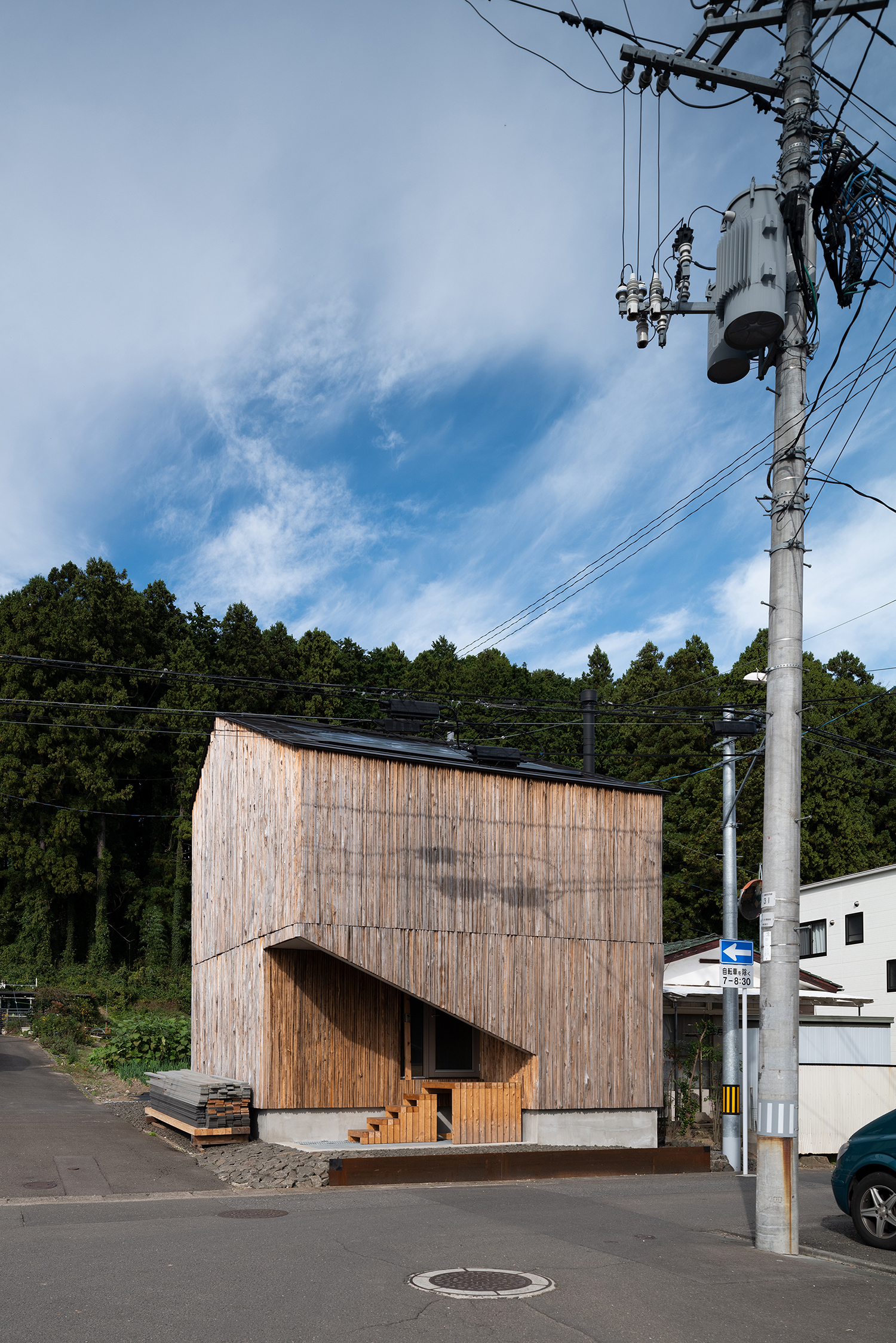
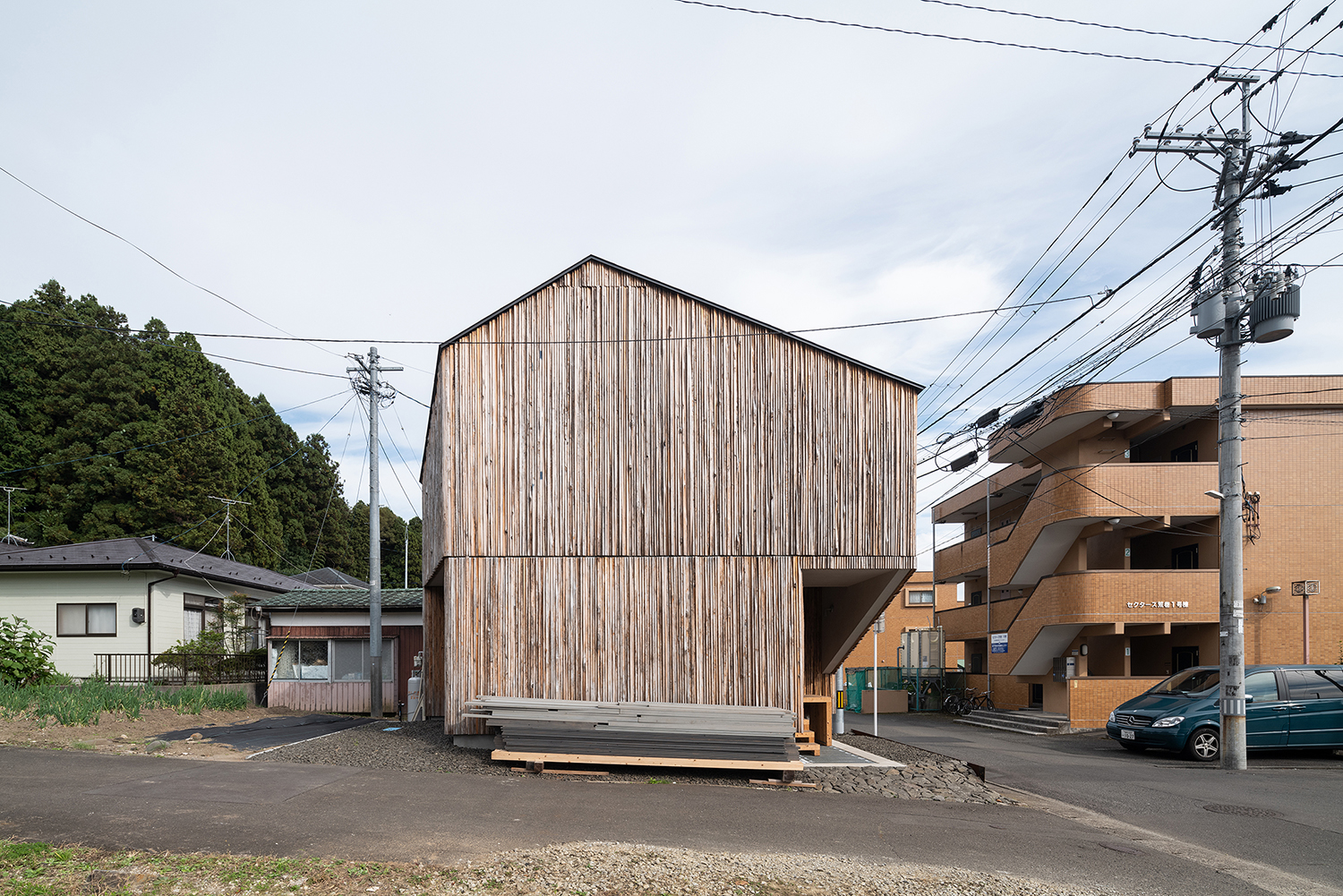
荒巻本沢の家
現代の木の家をつくる
本計画の施主は、これまで私が設計してきた住宅の施工を数多く手がけてきた工務店の社長の家である。協働を重ねる中で、性能を重視する私の家づくりに共感を深め、その延長として自邸の設計を任せてくれた。
日常的に設計・施工の現場に身を置く立場にあるため、一般的な施主と比べても実験的な試みに対する理解が深く、以前から構想していた構法的な挑戦に取り組む貴重な機会を与えてくれた。
本計画のコンセプトは、「現代の木の家をつくる」こと。
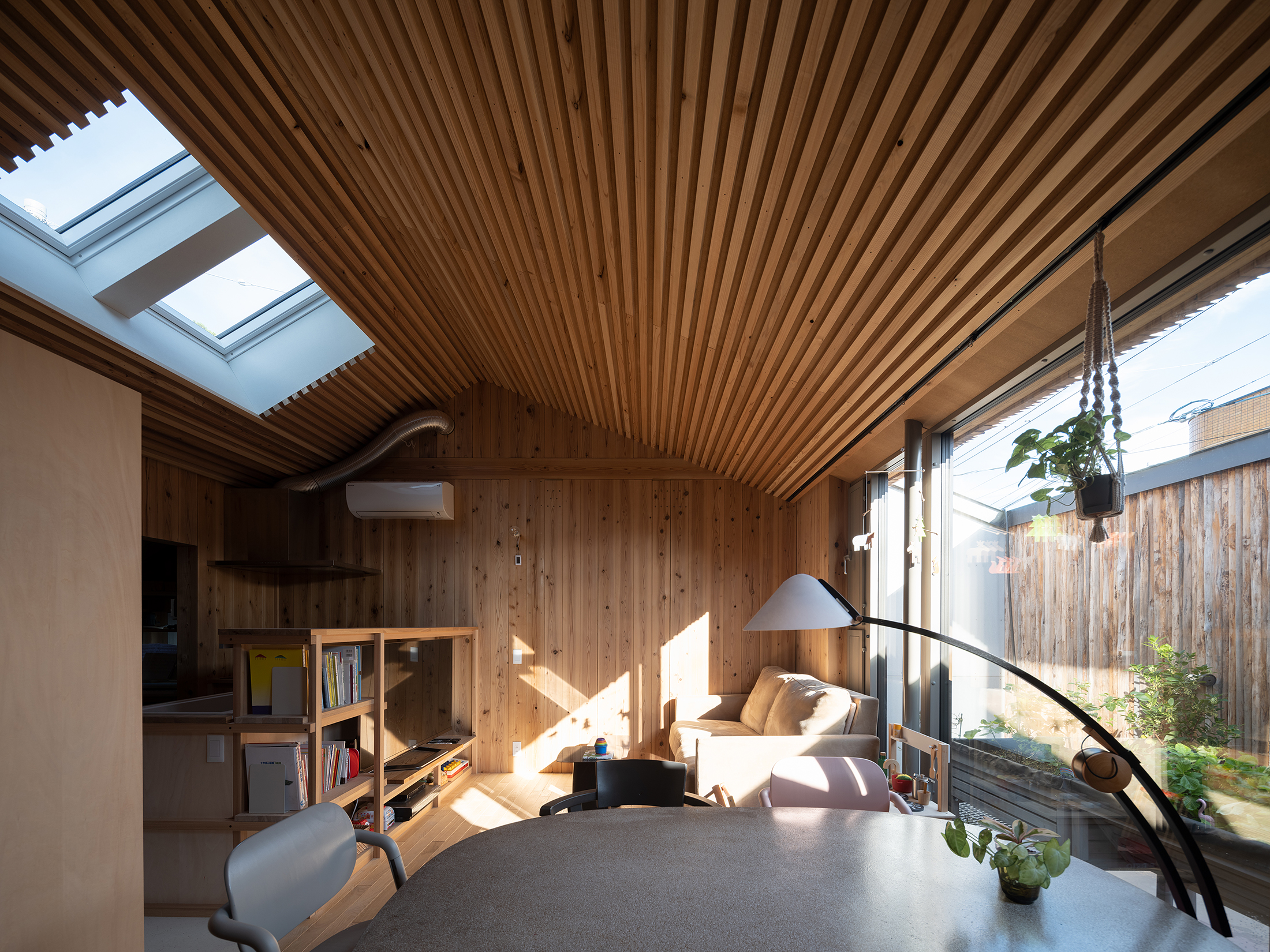
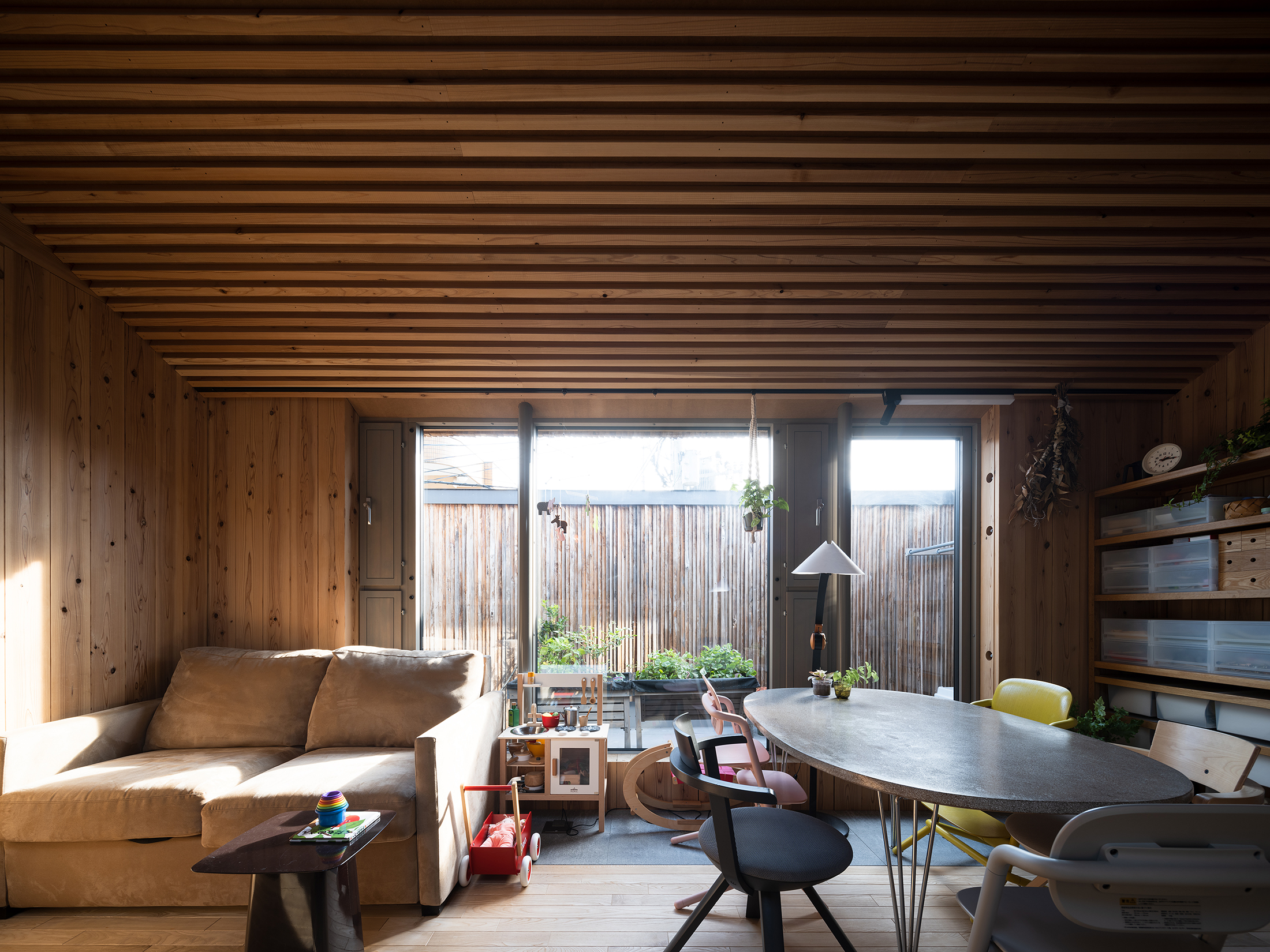
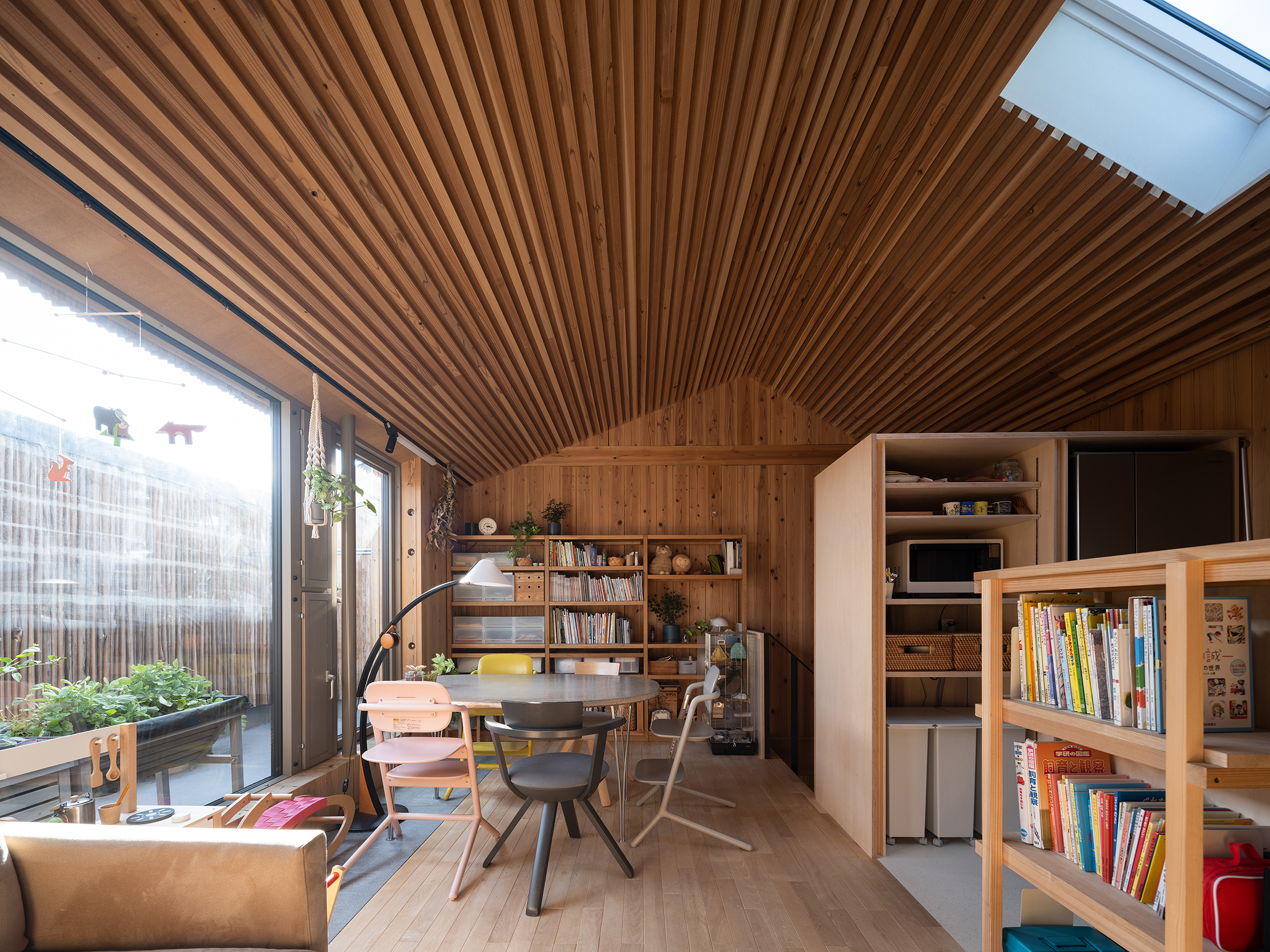
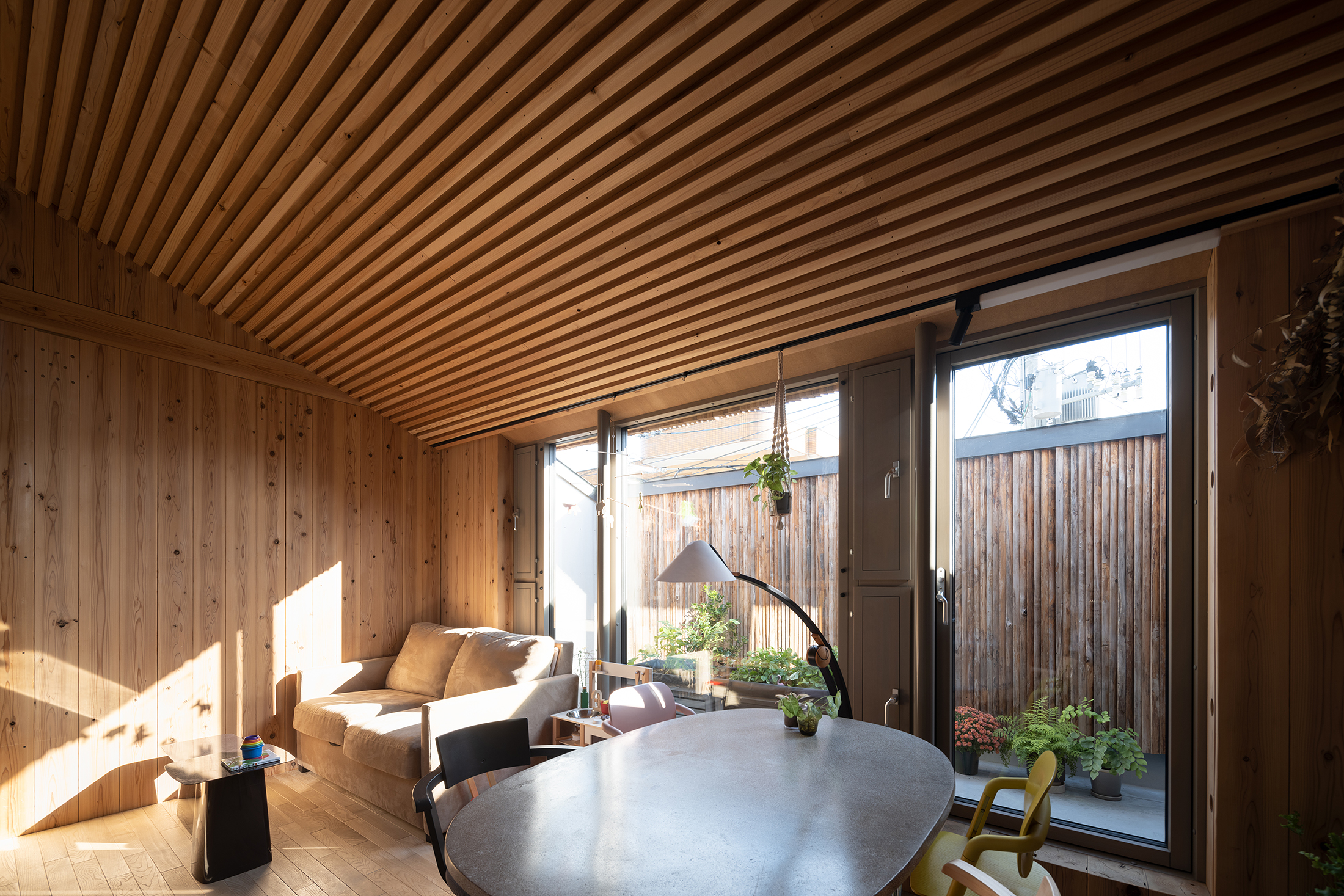
内部も外部も、可能な限り木で構成し、木そのものを量塊として成立させる住宅を、施主とともに模索した。
「縦ログ構法」という選択
木材は多孔質であり、それ自体が断熱性能を備えている。であれば、断熱材に過度に頼るのではなく、木そのものを厚く用いることで必要な性能を確保できないか、その発想から検討を重ね、施工性と普及性を踏まえて採用したのが「縦ログ構法」である。
南会津町のはりゅうウッドスタジオが手がける実例を施主とともに見学し、壁倍率や準耐火構造における大臣認定を取得した、合理性の高い構法であることを確認した。
一般的なログハウスのように丸太を横に積み上げるのではなく、製材したスギ材を縦方向に組み上げる点が特徴である。
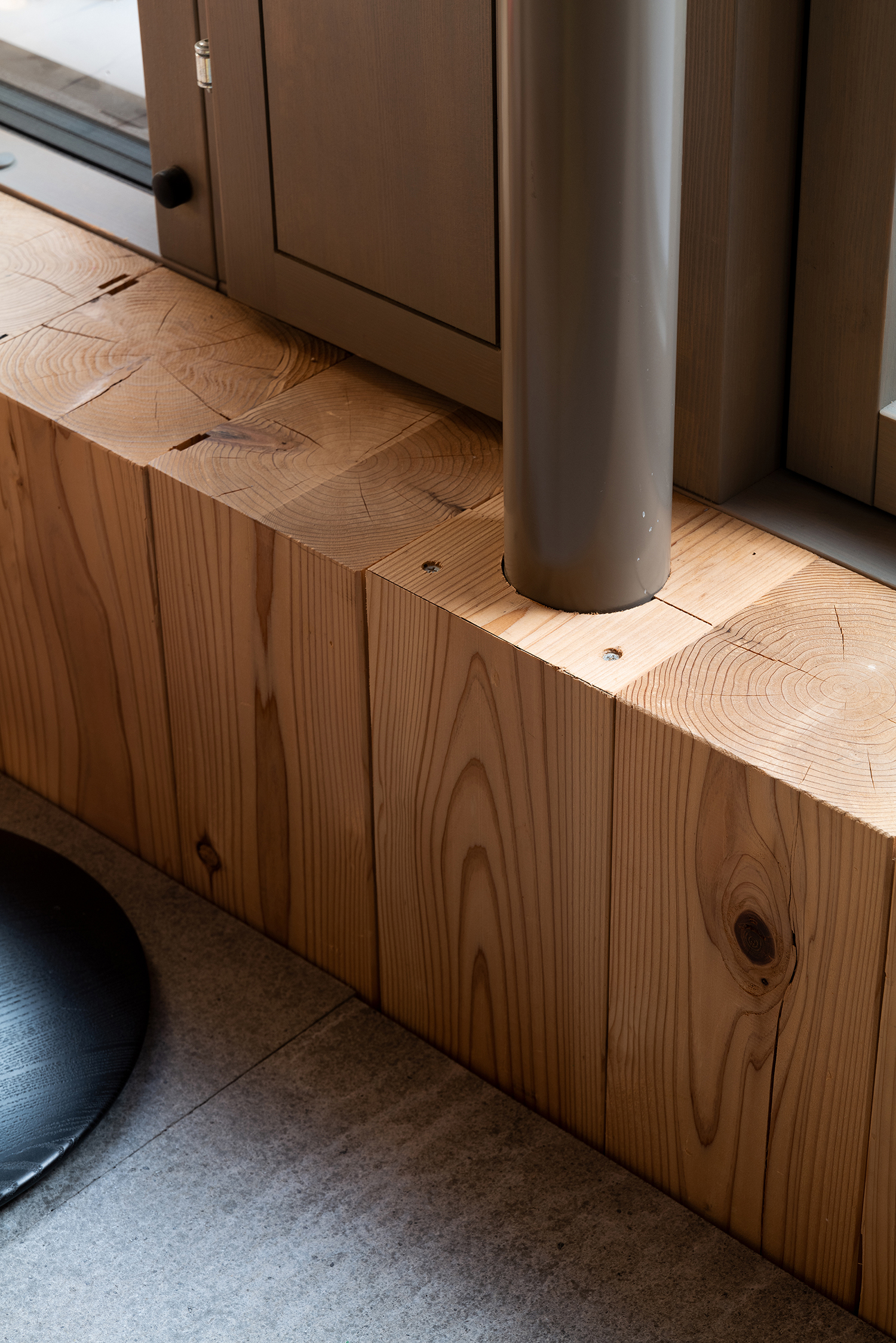
最大の利点は、接着剤を使わずに角材を7本ボルトで緊結し、運搬可能なサイズのパネル化できる点にある。製材所でパネル化された縦ログ材を現場に搬入・組み立てるため、施工性と施工効率に優れ、普及性の高い構法といえる。
壁構成が生む性能と表情
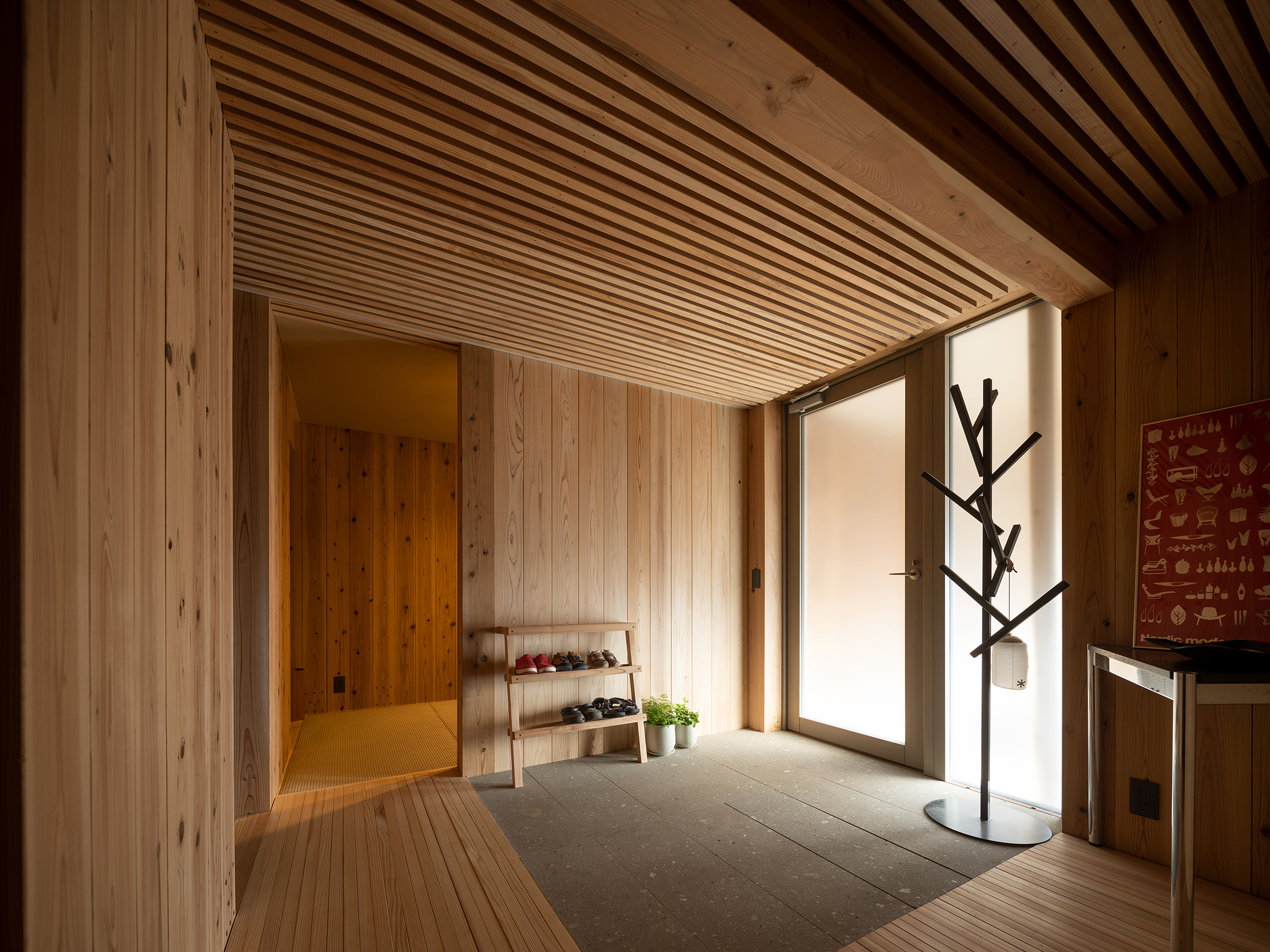
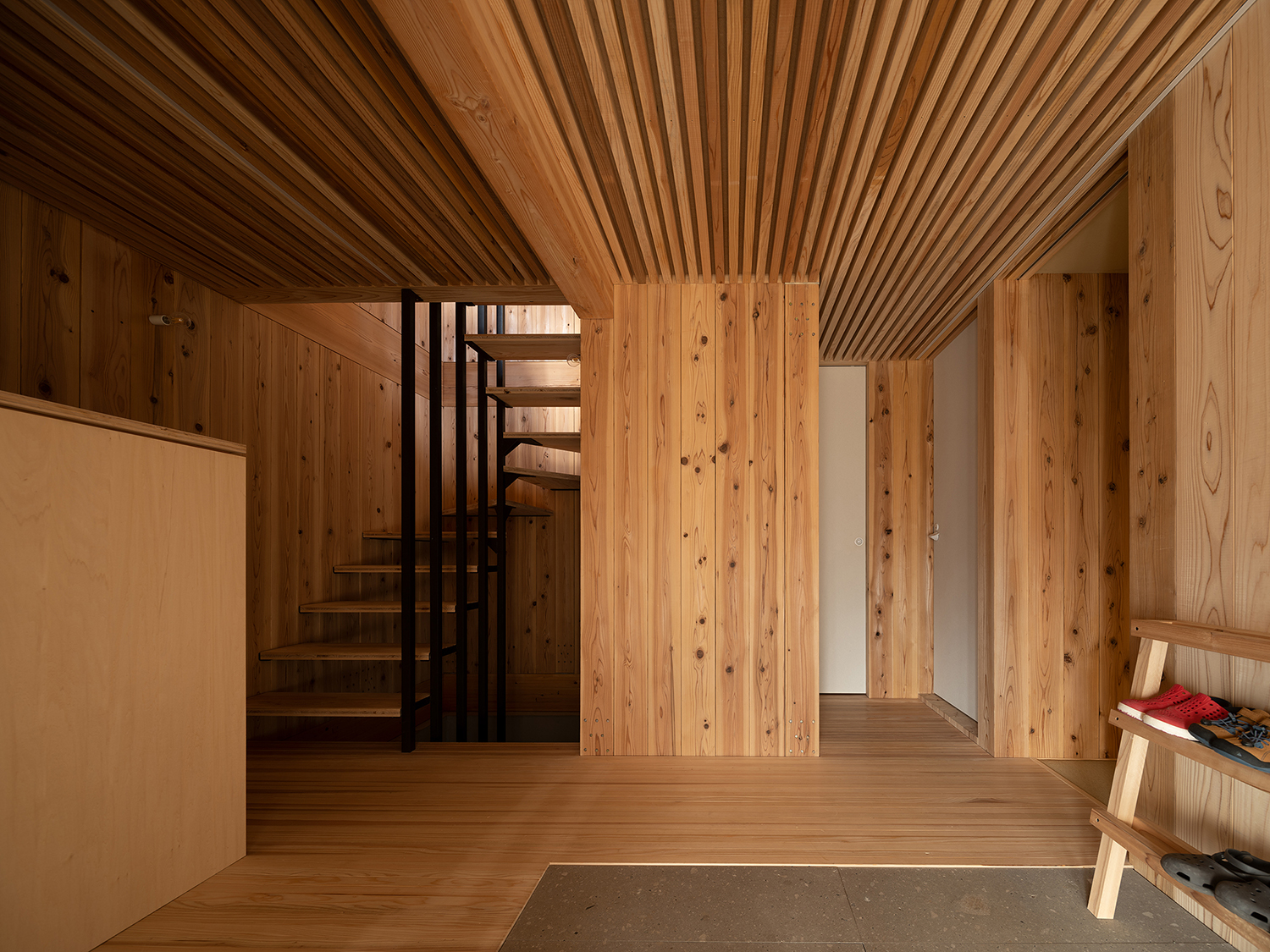
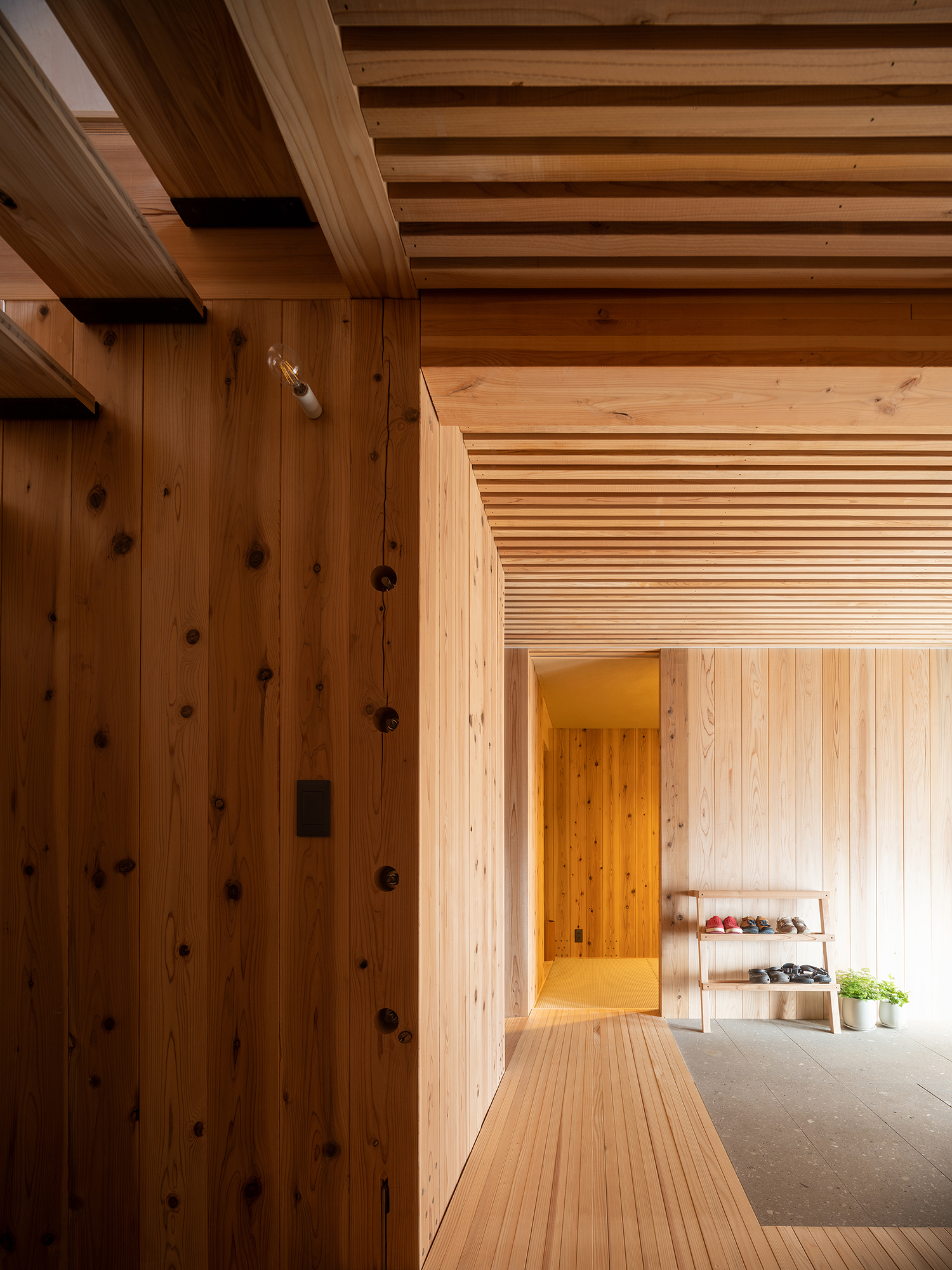
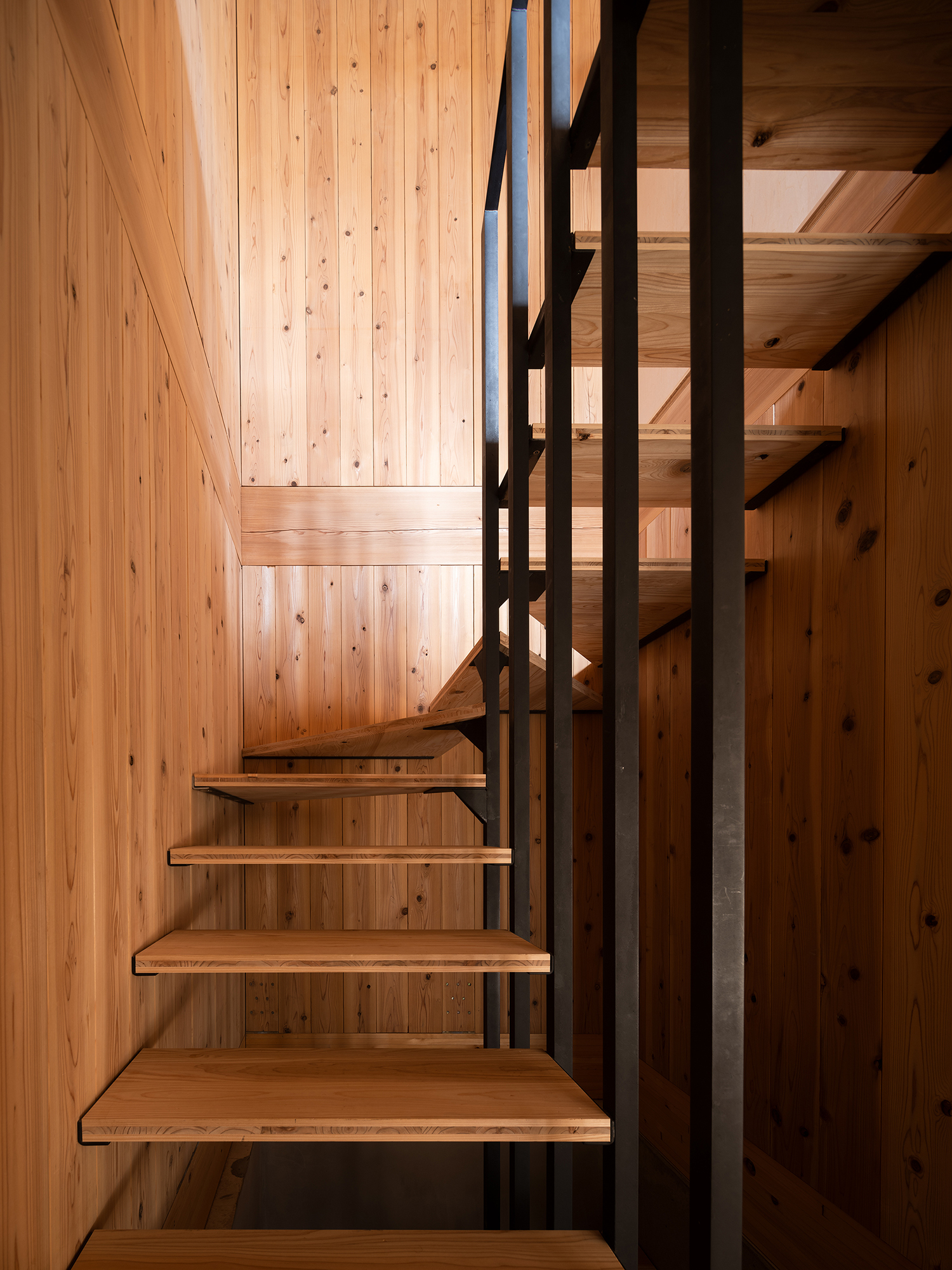
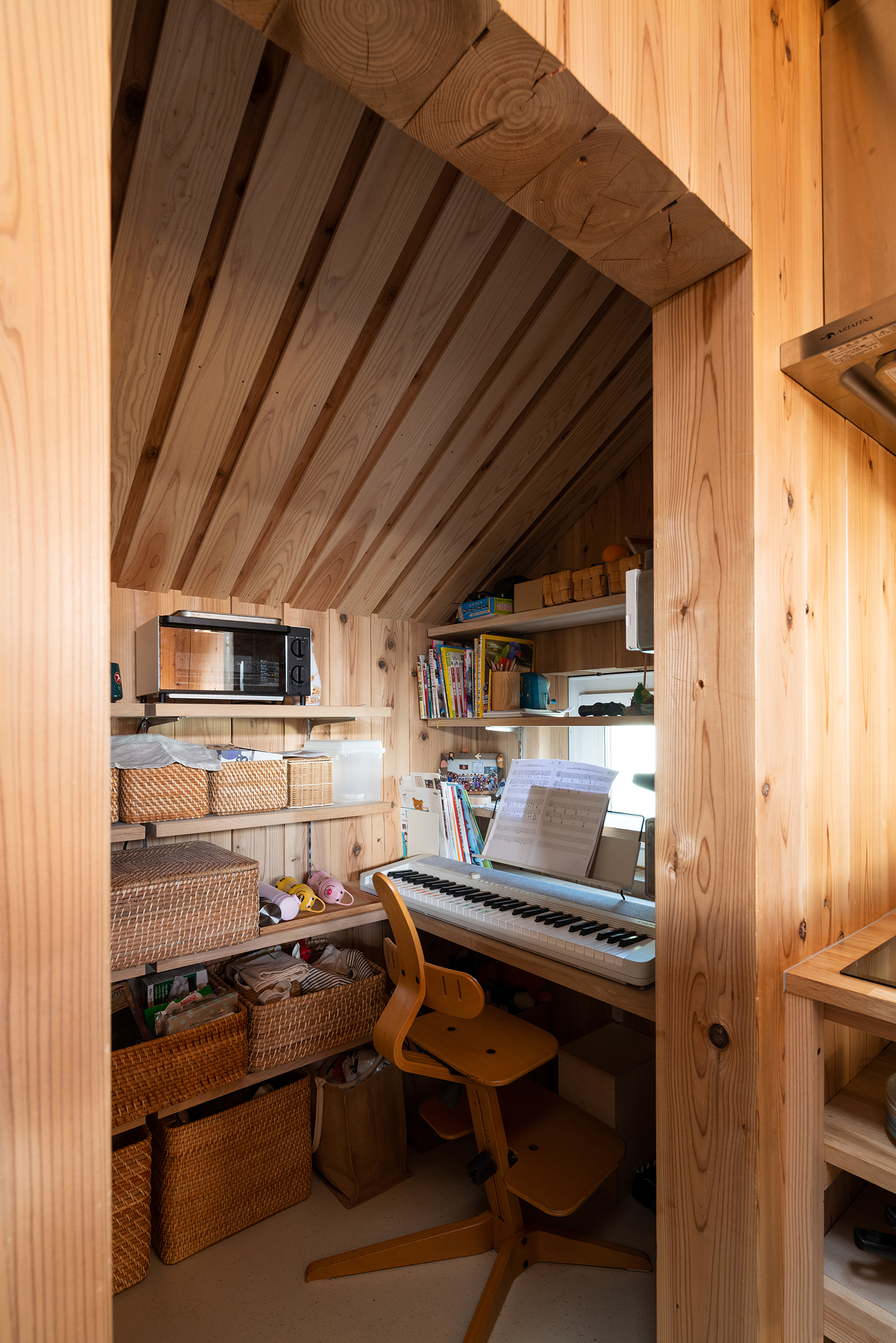
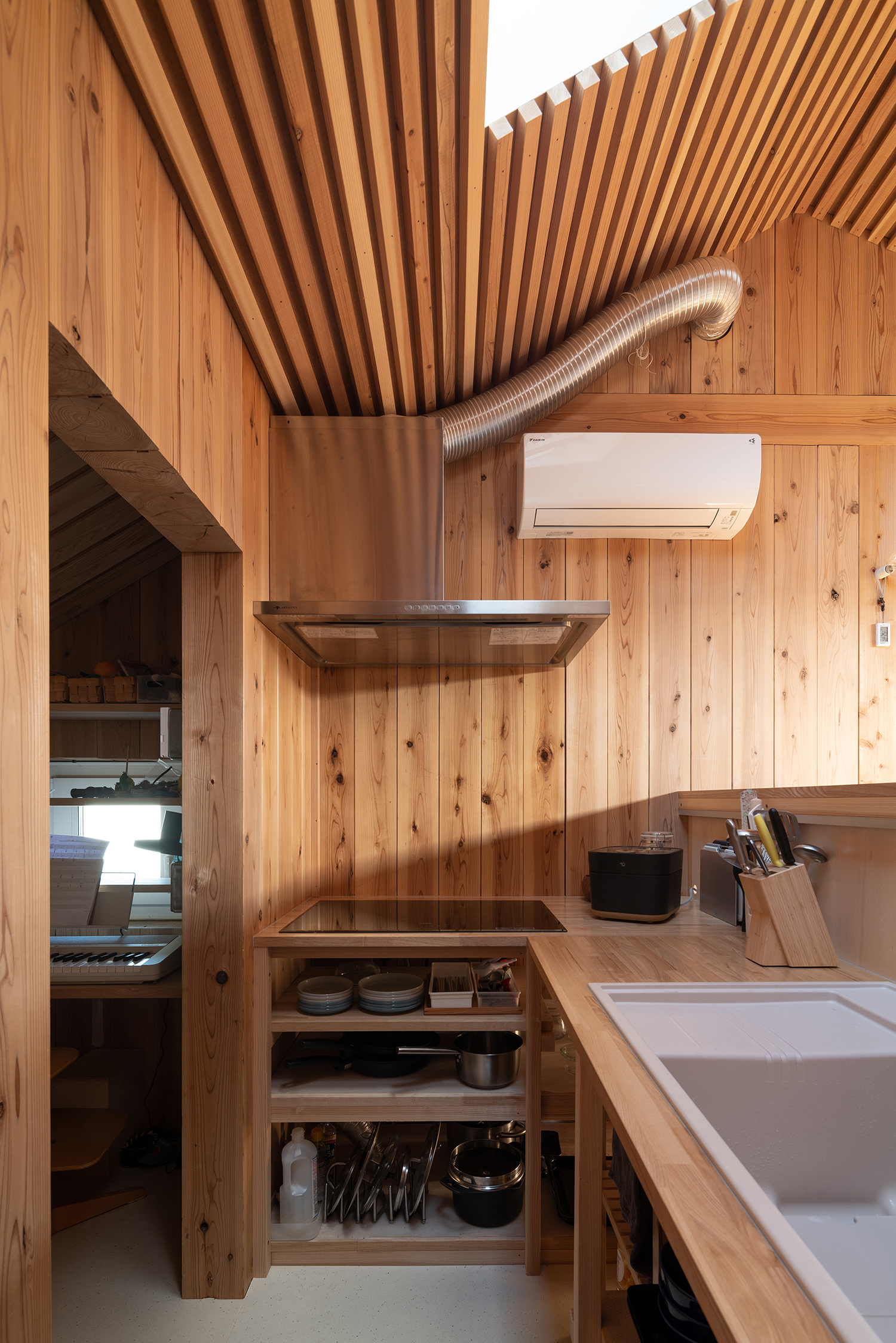
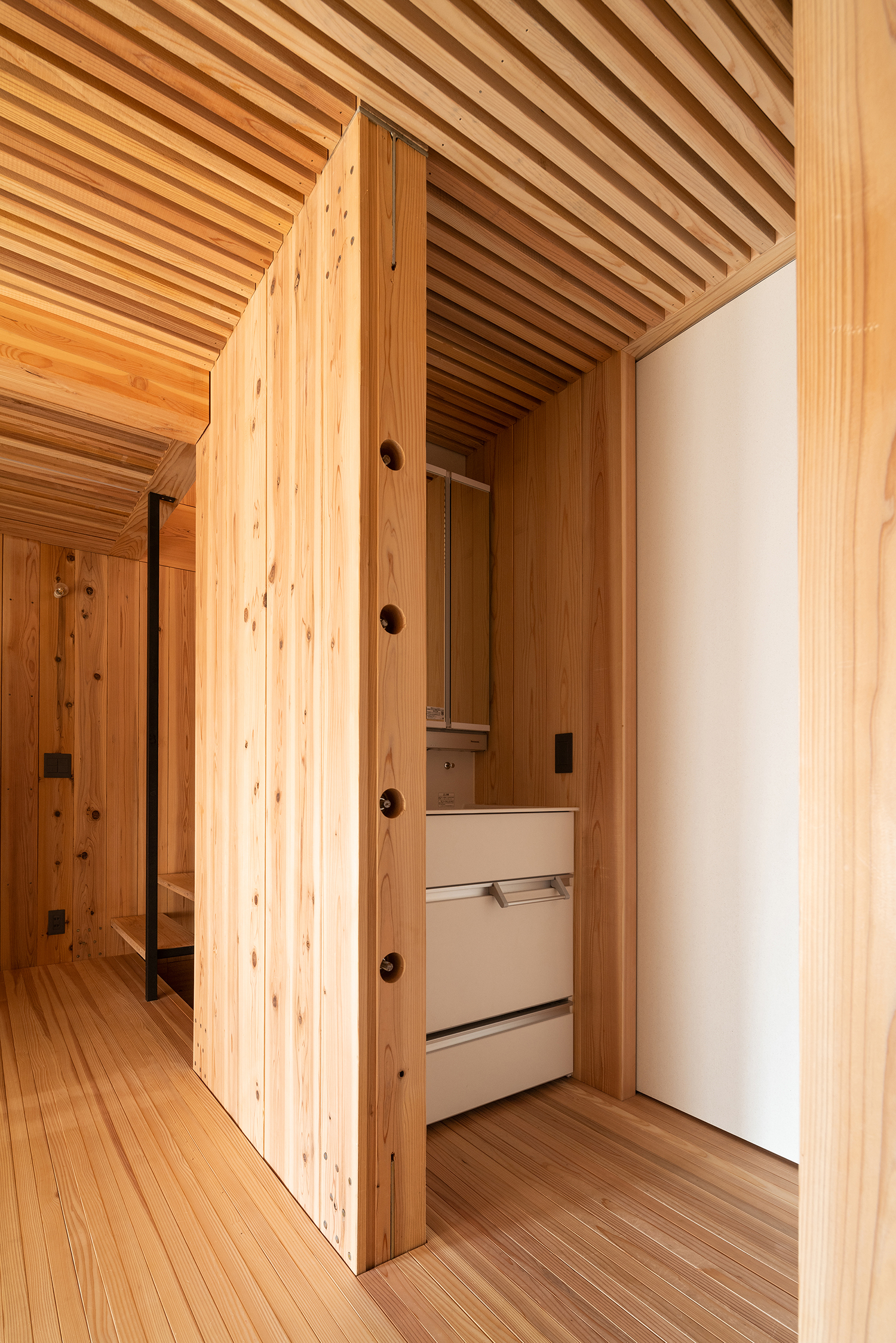
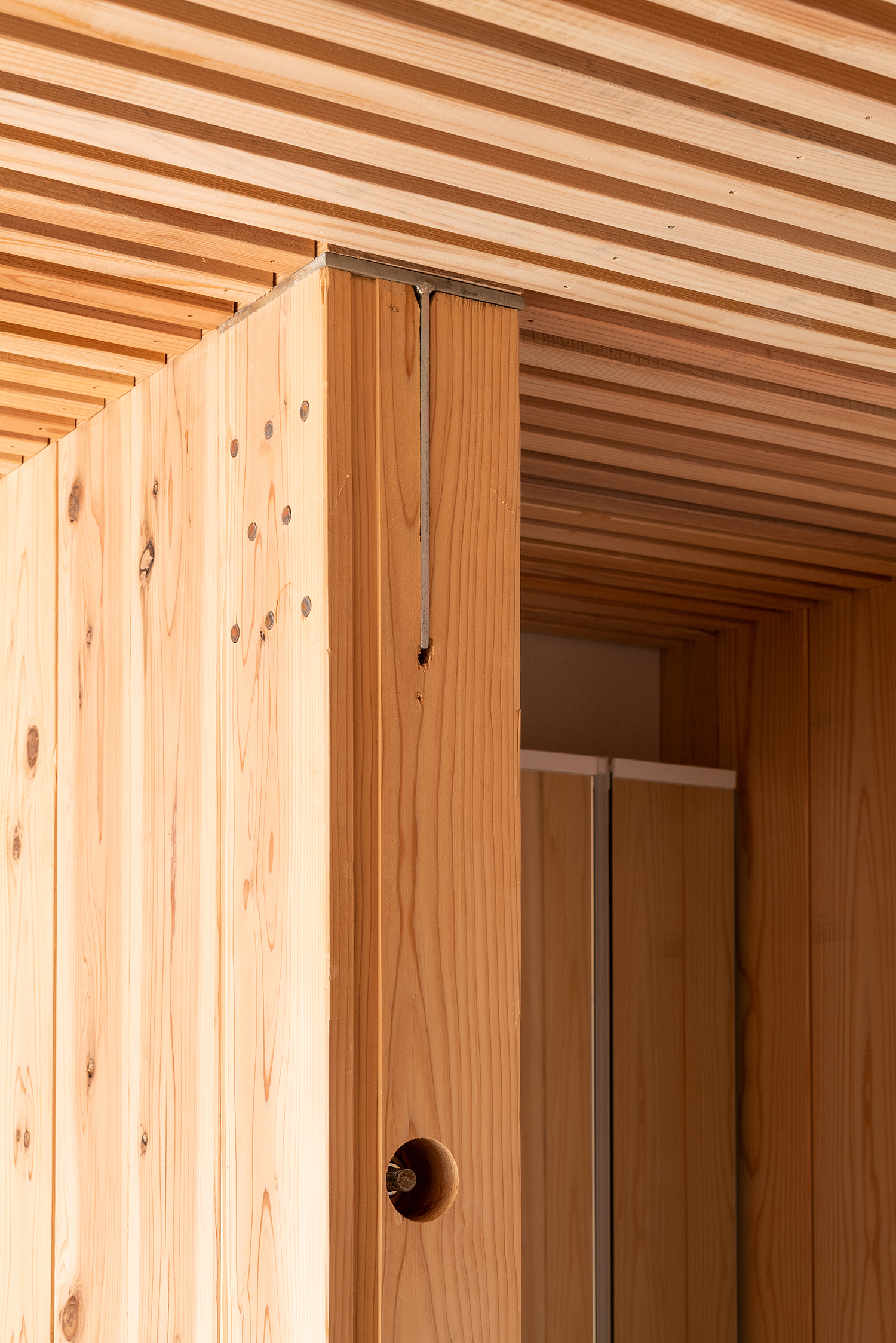
内壁には石膏ボードを用いず、パネル化した150mm角の縦ログ材をそのまま現しとしている。
さらに外側には、90mmの木材、90mmの木質繊維断熱材、45mmの透湿防水層を重ね、外壁には屋久島杉の端材45mmを張ることで、合計420mmの壁厚を確保した。これにより、壁倍率4.7倍、UA値0.27W/㎡・Kという高い断熱・耐力性能を実現している。
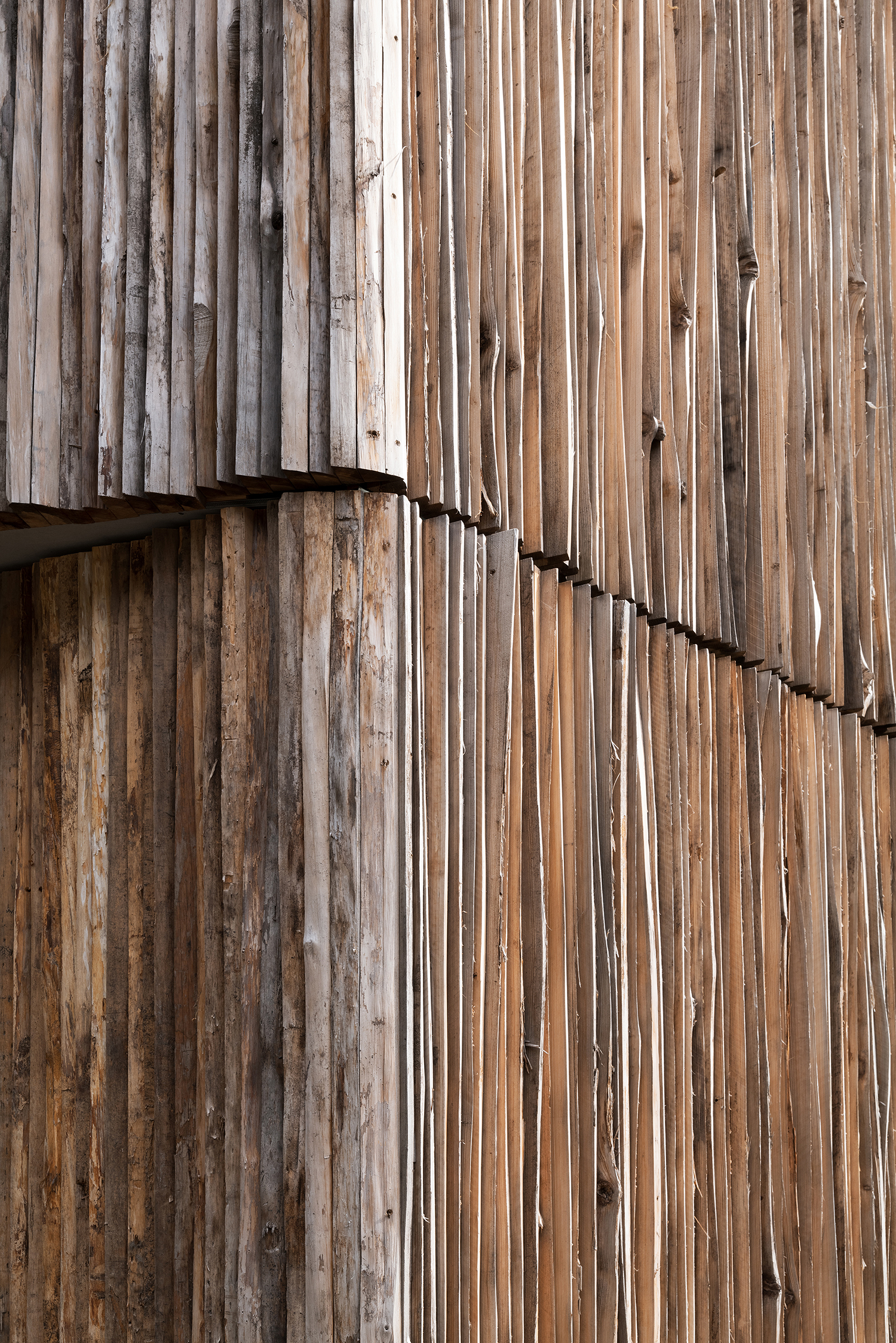
外壁材には、屋久島杉の皮に近い表層材を採用した。一般に構造材として用いられるのは芯材だが、表層材であっても十分な厚みを確保すれば、耐力上の問題はない。むしろ、表層材ならではの荒々しく豊かなテクスチャが、この住宅にはふさわしいと考えた。
結果として、外壁から内壁にかけて、一本の木を思わせる断面的な構成が自然に立ち上がっている。
厳しい制限が導いた階層構成
狭小敷地に家族5人の暮らしをいかに成立させるかも、本計画における大きな課題であった。敷地面積25.91坪という条件のもと、2台分の駐車スペース確保、外壁後退、高さ制限といった複数の制約が重なった。
これらを踏まえ、地上2階・地下1階の三層構成とすることで、暮らしに必要最低限となる延床面積27.10坪を確保している。
南側にアパートが隣接するため、LDKは2階に配置し、視線を切りつつ安定した採光を得た。リビングに連続するテラスは外壁で囲い、周囲を気にすることなく、空と光を感じられる場として機能している。
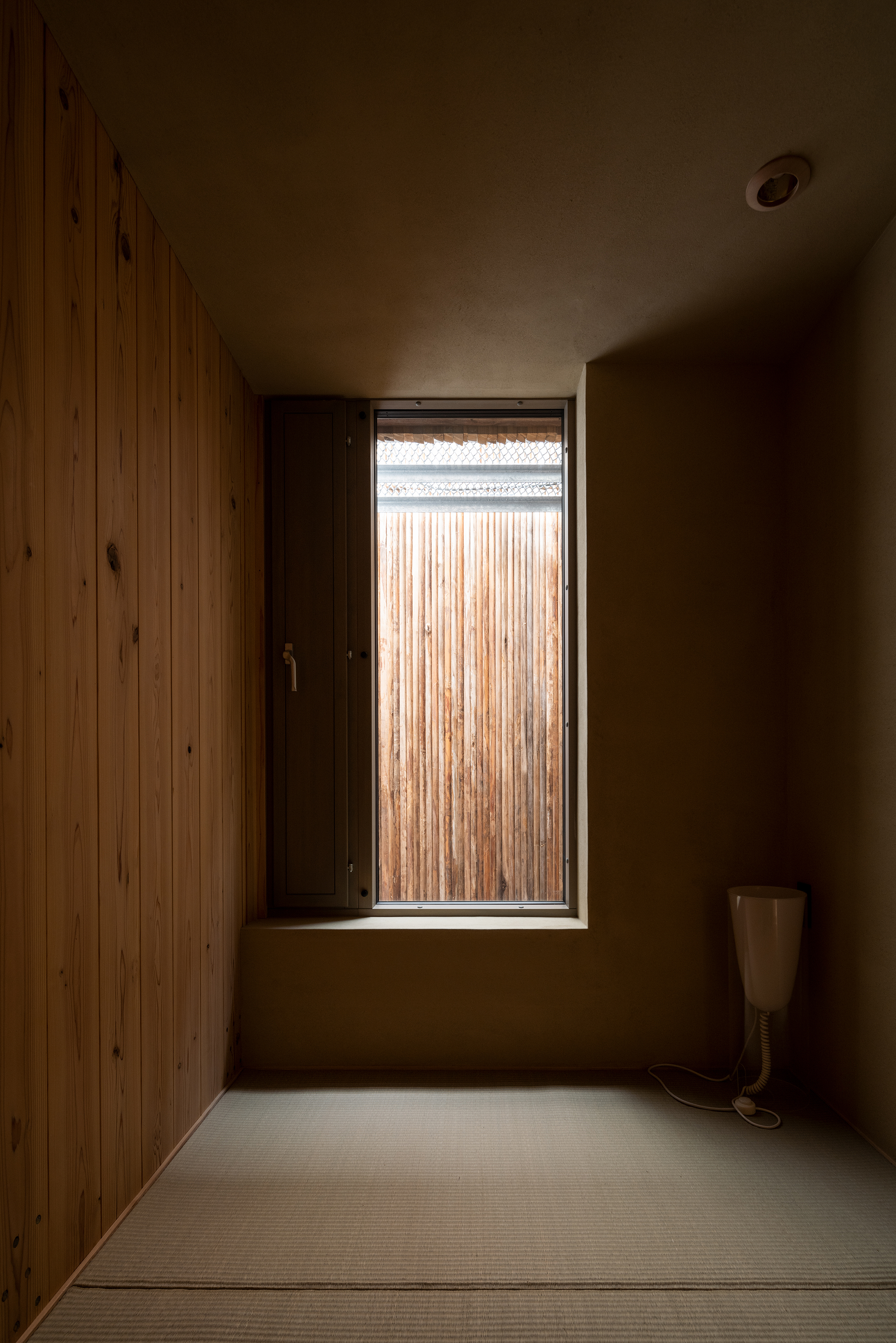
1階には玄関、水まわり、和室を配置し、地下には寝室とドライエリアを設けた。2階から地下へと連続する吹き抜けと天窓により、地階にも自然光が届き、閉塞感のない空間となっている。
上下階を活かした温熱環境
この三層構成は、結果として快適な温熱環境を成立させるうえでも大きな意味を持った。
寝室を設けた地階は地中熱の影響を受け、夏でも室温が安定して低く、冷房に頼らず快適に眠ることができる。冷えた空気は浮力換気によって上階へと穏やかに導かれる。
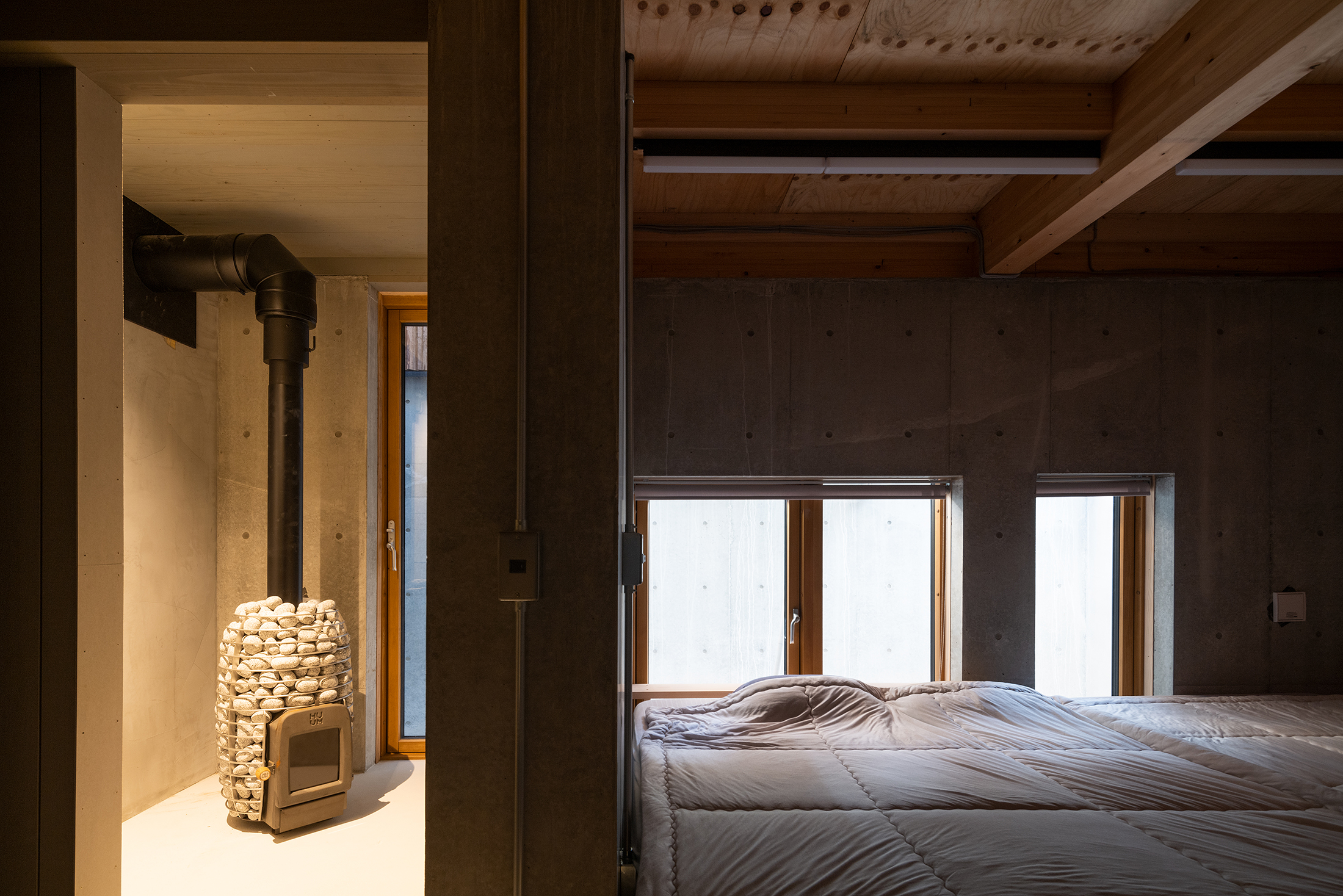
一方、冬季には地階に設けた薪サウナが熱源となり、コンクリートと木の量塊がじっくりと熱を蓄える。暖気は上下階を巡り、住まい全体を放射熱で包み込む。
全館を一様な温度に整えるのではなく、上下階に緩やかな温度差を残すことで、季節ごとに心地よい居場所が自然に生まれている。
その快適さの根底に、木の量塊を核とした空間構成があることは言うまでもない。
「現代の木の家」を模索する試みとして始まった本計画。
木が本来備える断熱性、調湿性、熱容量といった性質を最大限に引き出すことで、現代における木の住宅の可能性を、ひとつの具体的なかたちとして提示できたと考えている。
ARAMAKI HONSAWA HOUSE
CREATING A CONTEMPORARY WOODEN HOUSE
The client for this project is the president of a construction company that has built many of the houses I have designed over the years. Through repeated collaboration, he developed a deep sympathy for my performance-oriented approach to residential design, and as a natural extension of that relationship, entrusted me with the design of his own home.
Because he is constantly engaged in design and construction work himself, he possesses a far greater understanding of experimental approaches than a typical homeowner. This allowed me the rare opportunity to pursue a structural challenge I had been considering for some time.
The central concept of this project was to “create a contemporary wooden house.”
Together with the client, we explored a form of housing in which both interior and exterior are composed almost entirely of wood, allowing the material itself to exist as a solid architectural mass.
THE CHOICE OF THE “VERTICAL LOG CONSTRUCTION” METHOD
Wood is a porous material that inherently possesses thermal insulation properties. From this perspective, we questioned whether it might be possible to secure sufficient performance not by relying heavily on conventional insulation materials, but by using wood itself in greater thickness.
After extensive study, and with careful consideration of constructability and adaptability, we adopted the “vertical log construction” method.
Together with the client, we visited built examples by Haryu Wood Studio in Minamiaizu Town, confirming that this system is a highly rational construction method that has obtained ministerial certification for wall strength and quasi-fire-resistant structures.
Unlike conventional log houses, which stack logs horizontally, this method assembles milled cedar members vertically.
Its greatest advantage lies in the fact that square timber members are tightly fastened with seven bolts—without the use of adhesives—into transportable panel units. These vertical log panels are prefabricated at the sawmill and assembled on site, resulting in excellent constructability, high construction efficiency, and strong potential for wider adoption.
PERFORMANCE AND EXPRESSION CREATED BY THE WALL ASSEMBLY
For the interior walls, no gypsum board is used; instead, the 150 mm square vertical log panels are left exposed as the finished surface.
On the exterior side, the wall assembly layers 90 mm of wood, 90 mm of wood-fiber insulation, and a 45 mm vapor-permeable waterproof layer. The outermost finish consists of 45 mm boards made from leftover Yakushima cedar. This results in a total wall thickness of 420 mm, achieving a wall strength factor of 4.7 and a high thermal performance with a UA value of 0.27 W/m²·K.
The exterior cladding uses surface-layer boards cut close to the bark of Yakushima cedar. While structural lumber typically relies on heartwood, surface wood can also provide sufficient strength when used in adequate thickness. More importantly, we felt that the raw, richly textured character unique to surface wood was especially well suited to this house.
As a result, the sectional composition from exterior to interior naturally evokes the image of a single, massive piece of wood.
A LAYERED SPATIAL CONFIGURATION SHAPED BY CONSTRAINTS
Another key challenge was how to accommodate a family of five on a compact site. With a site area of just 25.91 tsubo, the project was subject to multiple constraints, including space for two parking vehicles, setback regulations, and height limitations.
By adopting a three-level configuration—two stories above ground and one basement level—we secured the minimum necessary total floor area of 27.10 tsubo to support daily living.
Because an apartment building stands immediately to the south, the LDK was placed on the second floor, allowing privacy while ensuring stable daylight. A terrace adjoining the living room is enclosed by exterior walls, creating a space where residents can enjoy the sky and natural light without concern for surrounding views.
The first floor contains the entrance, wet areas, and a Japanese-style room, while the basement houses the bedrooms and a dry area. A vertical void connecting the second floor to the basement, combined with a skylight, allows natural light to reach the lower level, eliminating any sense of confinement.
A THERMAL ENVIRONMENT UTILIZING VERTICAL STRATIFICATION
This three-level composition ultimately played a significant role in establishing a comfortable thermal environment.
The basement level, which contains the bedrooms, benefits from geothermal stability, maintaining cooler indoor temperatures even in summer and allowing for comfortable sleep without reliance on air conditioning. The cool air is gently guided upward through buoyancy-driven ventilation.
In winter, a wood-fired sauna located in the basement serves as the primary heat source, gradually storing heat in the concrete and wooden mass of the structure. Warm air circulates through the vertical spaces, enveloping the entire house in radiant heat.
Rather than maintaining a uniform temperature throughout, the design allows for gentle thermal gradation between floors, naturally creating comfortable places to inhabit in different seasons.
Underlying this comfort is, without question, a spatial composition centered on the solid mass of wood itself.
荒巻本沢の家
所在地/宮城県仙台市
主要用途/専用住宅
<設計>
意匠 菊池佳晴建築設計事務所 担当/菊池佳晴 遠藤和郎
構造 はりゅうウッドスタジオ 担当/滑田崇志
<施工>
建築 ねぐら設計室 担当/菅藤純
<構造・構法>
主要構造・構法/木造在来構法+地下RC造
基礎/べた基礎
構造/許容応力度計算
<規模>
階数/地上2階 地下1階
軒高/6030mm 最高高さ/7227mm
延床面積/建築物89.60m2(27.1坪)
<工程>
設計期間/2018年10月〜2020年8月
工事期間/2020年9月〜2022年3月
<敷地条件>
都市計画区域内 市街化区域
第一種低層住宅専用地域
許容建蔽率50% 許容容積率80%
外壁後退距離1m
地域地区 22条地域
地区計画 無し
道路幅員 南8.15m(公道)
<外部仕上げ>
屋根/ガルバリウム鋼板t0.35横葺き
太陽光発電パネル エコテクノルーフ(タニタ)
外壁/屋久島地杉端材45mm
開口部/木製トリプルサッシ(ノルド)
<内部仕上げ>
床/杉木板貼り45mm
壁/縦ログ杉角材150mm表し
天井/木板目透かし張り
<設備システム>
暖房/サウナ用薪ストーブ
冷房/高効率エアコン
換気/三種換気
給排水 給水方式/直結
排水方式/下水道直結
給湯 給湯方式/ガス給湯器(プロパンガス)
<断熱仕様>
基礎/防蟻EPSパフォームガードタイプ100mm
基礎下/EPSパフォームガードタイプ50mm
壁(充填)/縦ログ 杉材150mm
壁(付加)/杉材120mm+木質繊維断熱材90mm
屋根/ウッドファイバー400mm
<温熱計算>
Ua値/0.27W/m2K
C値/1.2cm2/m2
<撮影>
西川公朗